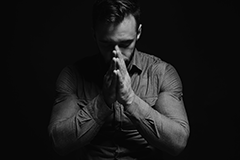

Does Anxiety Mean I Lack Faith?
Anxiety can feel like a spiritual failure. Here is what Scripture actually says, and why a racing mind is not evidence of a small faith.
It usually arrives at night. The house is finally quiet, your body is tired, and your mind picks that exact moment to start listing everything that could go wrong. And then, somewhere underneath the worry, a second and heavier thought shows up. If I really trusted God, would I be lying here like this?
That question does more damage than the anxiety ever did. It takes something painful and turns it into evidence against you. Now you are not only anxious, you are anxious about being anxious, and you have started to wonder whether God is disappointed in the whole mess.
So let us take that question seriously and answer it honestly, because the answer is kinder than the one most of us have been carrying.
Is anxiety a sin?
The short answer is no. Anxiety is a condition of a body and a mind living in a broken world, and Scripture treats it that way far more often than we do.
Part of the confusion comes from a single word doing too much work. In English, anxiety covers a wide field. It covers the worry that comes from refusing to trust God with tomorrow. It also covers panic that grips your chest for no reason you can name, the racing pulse that wakes you at three in the morning, the diagnosis you did not ask for. Those are not the same thing, and Scripture does not treat them as if they were.
The Bible does warn us about the kind of worry that quietly says God cannot be trusted. That warning is real, and it is loving, because that kind of worry steals from us. But nowhere does Scripture hand a struggling person a verse as a rebuke. It hands them a Father.
What does Philippians 4:6 actually mean?
This is the verse that gets used against anxious people most often. Paul writes, "do not be anxious about anything" (Philippians 4:6 ESV), and if you stop reading there, it sounds like a command you have already failed.
But look at what comes next in the same sentence. Paul does not say do not be anxious, try harder. He says do not be anxious, and then immediately tells you where to put the anxiety: in prayer, in petition, with thanksgiving, brought to God. The verse is not a door slamming. It is a door opening. It assumes you have anxiety and tells you what to do with it.
Peter says the same thing with even more tenderness: "casting all your anxieties on him, because he cares for you" (1 Peter 5:7 ESV). All of them. Not the respectable ones. The verse only makes sense if God expects you to arrive with your hands full.
Read that way, these are some of the most compassionate sentences in the New Testament. They were never meant to be used as a measuring stick.
Did anyone in the Bible struggle with fear?
Constantly. David wrote entire psalms from the floor. Elijah, days after the greatest victory of his ministry, sat under a tree and asked God to let him die. Hannah prayed so intensely that the priest assumed she was drunk. Paul told the Corinthians about fears within and conflicts outside.
And then there is Gethsemane. On the night before the cross, Jesus said to His friends, "My soul is very sorrowful, even to death" (Matthew 26:38 ESV). He sweat like drops of blood. He asked His Father three times if there was another way. If overwhelming distress were proof of weak faith, that garden would make no sense at all.
Notice what God does in each of these scenes. He does not lecture. With Elijah, He sends food and sleep before He sends a word, which should tell us something about how seriously God takes a tired body. With David, He receives the complaint and stays. The psalmist writes, "When the cares of my heart are many, your consolations cheer my soul" (Psalm 94:19 ESV). Many cares, and comfort right there in the middle of them.
What can I actually do when the anxious thoughts come?
Here is what I would tell a friend across the table.
Start by telling God the truth, out loud if you can. Not a polished prayer. The actual sentence. I am afraid of this and I do not know what to do. The Psalms are full of that voice, which means God has already made room for it. If praying feels impossible right now, our prayer page is a good place to begin, and you can borrow the words of a psalm until yours come back.
Then give your mind something true to hold. Anxiety is loud and repetitive, so it helps to have one verse you know by heart, ready before you need it. Psalm 94:19 is a good one. So is Psalm 103:14, which says of God that "he knows our frame; he remembers that we are dust" (Psalm 103:14 ESV). He is not surprised by your fragility. He built you and He remembers.
Care for the body God gave you, because it is not separate from your soul. Sleep. Food. A walk outside. Less scrolling after nine at night. This is not lesser spiritual work; ask Elijah.
And please hear this next part clearly. If anxiety is interfering with your sleep, your work, your relationships, or your ability to get through an ordinary day, talk to a doctor or a licensed counselor. Getting help is not a failure of faith any more than setting a broken arm is. God works through medicine and through trained, faithful people, and there is no spiritual prize for suffering alone.
Find one person who knows the real version of what you are carrying. Anxiety grows in isolation and shrinks when it is spoken. If you do not have that person yet, our mentors would be glad to walk with you.
And build a small daily habit of being with God that does not depend on how you feel. Ten minutes. Some of the women in our community keep the devotional from that month's Women's Box by the coffee maker so the morning has a starting point already chosen, though a Bible open to Psalms on the kitchen counter does the same work. If you are not sure where to begin, How Do I Start Reading the Bible? walks through it gently.
Your anxiety is not a verdict on your faith
Faith is not the absence of fear. Faith is what you do with fear. It is the anxious person who prays anyway, who opens the Bible anyway, who tells the truth to a friend anyway, who keeps showing up to a God she cannot always feel. That is not weak faith. That is faith doing the hardest thing it will ever be asked to do.
Some of the most faithful people I have known have also been the most anxious. The two were never in competition. They lived in the same chest, and the faith kept turning toward God with hands full and shaking, which is exactly what Peter said to do.
So the next time that second thought shows up at midnight, the one that says your fear is proof of something broken in your walk with God, you can answer it. He knows your frame. He remembers you are dust. And He has never once asked you to come to Him calm first.
With love,
Elise
A few questions people ask
Is anxiety a sin according to the Bible?
No. Scripture warns against the kind of worry that refuses to trust God, but it never treats fear or distress as sin in itself. Jesus Himself was overwhelmed with sorrow in Gethsemane, and the Psalms are full of honest fear brought straight to God.
What Bible verses help with anxiety?
Philippians 4:6 and 7, 1 Peter 5:7, Psalm 94:19, Psalm 103:14, and Matthew 11:28. Pick one, memorize it, and keep it where anxiety tends to find you, whether that is your nightstand or your phone screen.
Should a Christian take medication or see a counselor for anxiety?
Yes, if that is what you need. Seeking medical or professional care is wise stewardship of the body God gave you, not a shortage of faith. Talk with your doctor about what is right for your situation.
Why do I still feel anxious after praying?
Because prayer is not a switch, it is a relationship. Sometimes God calms the storm and sometimes He holds you inside it, and both are answers. Keep praying anyway, and let the peace come at its own pace.